Property Sheet
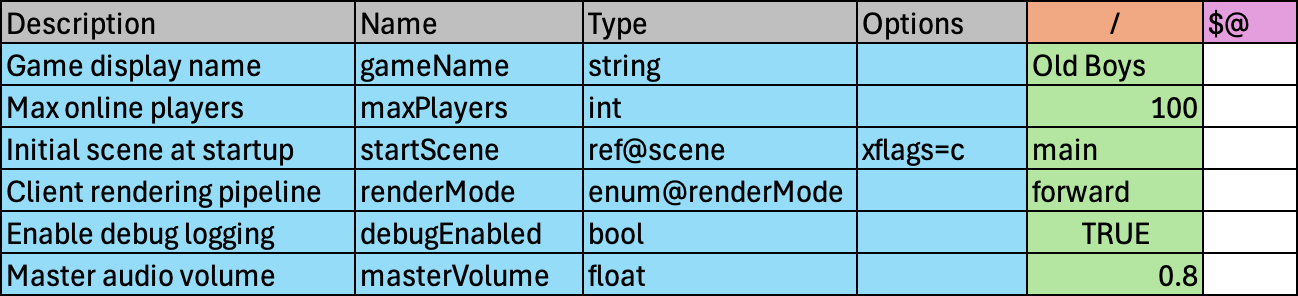
As shown in the figure below, the spreadsheet is divided into five functional regions:
- Property Sheet Marker (Pink)
- Superheader (Gray)
- Property Headers (Blue)
- Value Column Names (Orange)
- Property Values (Green)
Any spreadsheet using this specific five-region layout is a Property Sheet.
Property Sheet Marker
Section titled “Property Sheet Marker”The Property Sheet Marker (Pink) appears in the first row.
Its presence marks the spreadsheet as a property sheet, and the selected marker determines how value columns map to output files:
| Marker | Behavior |
|---|---|
$@ |
One output file per value column |
>>$@ |
All value columns bundled into a single file |
See Export Behavior for details.
Superheader
Section titled “Superheader”Superheader (Gray) sits at the start of the first row and labels the Property Headers (Blue), functioning as their meta-header.
The figure above demonstrates only the core labels: Description, Name, Type, and Options. They define the schema for each property; additional labels are available for advanced usage.
| Label | Required | Description |
|---|---|---|
| Description | Yes | A human-readable description with no functional effect on data export or code generation. Use - when no description is needed. Can be abbreviated as Desc. |
| Name | Yes | The property’s identifier, used in exported data and generated code; changing it affects all downstream output. |
| Type | Yes | The property’s data type and its default export value, e.g., int=/, where / represents the type’s zero value. |
| Options | No | Associated options. Used to filter properties, define constraints, or configure output. Multiple Options columns are allowed. |
See Also
Section titled “See Also”Property Headers
Section titled “Property Headers”Property Headers (Blue) lie below Superheader (Gray).
Each property occupies one row exactly. A property is valid only when its Description, Name, and Type are all present.
See Also
Section titled “See Also”Value Column Names
Section titled “Value Column Names”Value Column Names (Orange) head the property value columns, appearing in the first row to the right of Superheader (Gray).
Each name in this region heads a value column, holding one value per property.
- Names must follow the File Naming Rules.
- The special name
/carries a special meaning — see Export Behavior and Runtime Behavior. - Multiple such names are allowed.
Property Values
Section titled “Property Values”Property Values (Green) occupy the cells below the Value Column Names (Orange).
Cells in this region must conform to the Type and Options defined in the Property Headers.
See Also
Section titled “See Also”Export Behavior
Section titled “Export Behavior”$@ — one file per value column
Section titled “$@ — one file per value column”Each output file is named from the sheet’s export name (shown here as export-name):
| Value column name | Output file |
|---|---|
/ |
export-name |
scene1 |
export-name.scene1 |
xyz |
export-name.xyz |
Example of $@
Section titled “Example of $@”| Desc | Name | Type | / | hard | $@ |
| Player lives | lives | int | 5 | 3 | |
| Enemy damage multiplier | enemyDamage | float | 1 | 1.5 | |
| Allow continue after game over | allowContinue | bool | TRUE | FALSE |
{ "lives": 5, "enemyDamage": 1, "allowContinue": true}{ "lives": 3, "enemyDamage": 1.5, "allowContinue": false}>>$@ — single file
Section titled “>>$@ — single file”All value columns merge into one file, forming a map keyed by value column names.
Example of >>$@
Section titled “Example of >>$@”| Desc | Name | Type | / | hard | >>$@ |
| Player lives | lives | int | 5 | 3 | |
| Enemy damage multiplier | enemyDamage | float | 1 | 1.5 | |
| Allow continue after game over | allowContinue | bool | TRUE | FALSE |
{ "/": { "lives": 5, "enemyDamage": 1, "allowContinue": true }, "hard": { "lives": 3, "enemyDamage": 1.5, "allowContinue": false }}Runtime Behavior
Section titled “Runtime Behavior”$@ — the / file
Section titled “$@ — the / file”At runtime, the Archmage SDK loads a single exported file — by default, the one mapped to /.
>>$@ — the single file
Section titled “>>$@ — the single file”The single bundled file loads in full, the same as an ordinary config file.